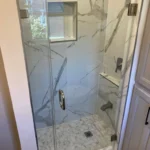
Ask five glass companies what a frameless shower enclosure costs and you’ll get five answers, usually followed by “it depends.” That’s frustrating, but it’s honest. No two shower openings are the same size, and a few choices you make move the price more than anything else.
This post walks through those choices so you can read a quote and know what you’re paying for.
Glass thickness
Most custom frameless enclosures use 3/8 inch or 1/2 inch tempered glass. Half-inch glass is heavier and stiffer, so a hinged door feels solid when it swings and doesn’t flex. It costs more because there is more glass, and the hinges and clamps have to carry more weight.
For fixed panels that never move, 3/8 inch is often plenty. Some homeowners use 1/2 inch for the door and 3/8 inch for the panels to keep the look while saving a little.
Layout and size
The layout is usually the biggest single factor.
- A single hinged door on a shower with walls on three sides is the simplest job: one piece of glass, two hinges, a handle.
- A door with one or two fixed panels adds glass, clamps and fitting time.
- A neo-angle corner enclosure has three pieces set at angles, each cut to match the walls.
- Knee walls and benches mean notched or angled glass, which takes more careful measuring.
- Full-height steam enclosures go up to the ceiling and usually need a transom panel on top.
Taller and wider openings cost more simply because there’s more glass to make and carry.
Glass type
Clear glass is the standard. A few upgrades change the price:
- Low-iron glass removes the faint green tint you see on the edge of regular glass. It shows up most on white or light tile.
- Frosted glass adds privacy, which helps in shared or small bathrooms.
- Gray and bronze tints give a darker, more modern look.
Hardware and finish
Hinges, handles, clamps and towel bars come in chrome, brushed nickel, matte black, brushed gold and brushed bronze. Solid brass and stainless steel cost more than cheaper alloys, and they hold up much better in a wet bathroom. Matching the finish to your faucet and shower head is worth the small difference.
Your walls and floor
Very few bathrooms are perfectly square. Walls lean, floors slope toward the drain, and tile adds thickness on one side and not the other. A good installer measures how far each wall is off plumb and cuts the glass to match, because tempered glass can’t be trimmed once it’s made.
The further off your walls are, the more fitting time the job needs. It’s rarely a deal breaker, but it’s one reason a quote over the phone is only a range.
Timing it with your remodel
We measure after the tile and the shower valve are finished, because tempered glass is cut to the final opening and can’t be trimmed later. If you’re in the middle of a remodel, call us when the tile is going in, and we can book the measurement for the day it’s done.
Why a kit costs less up front
Big-box shower kits are cheaper because they come in fixed widths. When your opening doesn’t match, the gaps get filled with trim strips and extra caulk. That’s usually where leaks and mildew start a year or two later. Custom glass costs more once and avoids paying twice.
How to get an accurate quote
You’ll get a closer number on the first call if you have this ready:
- A photo of the whole shower taken straight on, plus one from each side.
- The width of the opening at the top and at the bottom, and the height.
- Anything unusual: a bench, a half wall, a sloped ceiling, a steam unit.
- The finish you want, if you know.
Then ask each company whether the quote includes installation, the hardware finish you picked and a written warranty.
City Doors and Glass measures at your home for free and gives you a written estimate. See our frameless shower enclosure options or call 202-717-7099 to book a measurement.